lunes, 7 de noviembre de 2016

COP22 - principaux enjeux - principales cuestiones en juego

·      Quels sont les principaux enjeux de la COP22 ?

·      ¿Cuáles son las principales cuestiones que están en juego en la COP22?

Par/por Simon Roger

Source/fuente: Le Monde


« Le gros sujet de la COP22 sera de préciser les règles de mise en œuvre de l’accord de Paris et de se mettre d’accord sur la date de finali­sation de ces règles communes », prédit Laurence ­ Tubiana, l’ambassadrice chargée des négociations sur le changement climatique pour la France. L’entrée en vigueur étant effective depuis le 4 novembre, la première réunion des parties à l’accord de Paris (la CMA dans le vocabulaire onusien, sigle de COP serving as Meeting of the Parties to the Paris Agreement) sera donc convoquée dès la COP22.

“La principal cuestión de la COP22 será definir las reglas para la puesta en marcha del Acuerdo de París y ponerse de acuerdo sobre la fecha de finalización de estas reglas comunes”, predice Laurence Tabiana, la embajadora a cargo de las negociaciones sobre cambio climático para Francia. Siendo la entrada en vigencia efectiva a partir de este 4 de noviembre pasado, la primera reunión de las Partes del Acuerdo de París (CMA) será pues convocada a partir de la COP22.

CMA

(article 16)
The Conference of the Parties serving as the meeting of the Parties to the Paris Agreement, known as the CMA, will make decisions under the agreement.
La Conferencia de las Partes que sirve como reunión de las Partes del Acuerdo de París, conocida como CMA, tomará las decisiones según el acuerdo.


Cette CMA s’ouvrira le 15 novembre, journée lors de laquelle plusieurs chefs d’Etat et de gouvernement sont attendus à Marrakech, dont François Hollande  et le secrétaire d’Etat américain John Kerry. La proposition suivante y sera défendue : puisque la nouvelle organisation se met en place plus vite que prévu, pourquoi ne pas finaliser la discussion sur les règles communes dès 2018, l’année du point d’étape prévu par l’accord climat ?

Esta CMA se abrirá el 15 de noviembre, jornada a partir de la cual muchos jefes de estado son esperados en Marakech, entre los cuales François Hollande y el secretario de estado estadounidense John Kerry. La siguiente propuesta será defendida: puesto que la nueva organización está lista antes de lo previsto ¿por qué no finalizar el debate sobre las reglas comunes a partir de 2018, el año de verificación previsto para el acuerdo sobre el clima?


L’autre enjeu de la COP22 est de faire le point sur les engagements volontaires pris par les pays pour réduire leurs émissions de gaz à effet de serre et contrer les effets du réchauffement. Mises bout à bout, ces 189 « contributions nationales » développées à l’horizon 2025-2030 ne permettent pas de contenir le réchauffement sous le seuil de 2 °C. La COP22 devrait inviter les Etats à engager des actions additionnelles pour rehausser le niveau de leurs ambitions.

La otra cuestión en juego en la COP22 es hacer un balance de los compromisos voluntarios tomados por los países para reducir las emisiones de gases de efecto invernadero y contrarrestrar los efectos del calentamiento. Sumadas, estas 189 “contribuciones nacionales” proyectadas al horizonte 2025-2030 no permiten contener el calentamiento global debajo del umbral de los 2°C. La COP22 debería invitar que los estados se comprometan a encarar acciones adicionales para elevar el nivel de sus ambiciones.

Depuis la COP21, de nombreuses dynamiques ont vu le jour : l’alliance solaire internationale, l’initiative africaine pour les énergies renouvelables, la mission innovation, la coalition pour le prix du carbone, etc. Face à la difficulté de dresser un bilan de ces initiatives, la ministre de l’environnement marocaine, Hakima El Haite, et Laurence Tubiana vont proposer à Marrakech qu’un dispositif de suivi de ces coalitions soit mis sur pied d’ici à mai 2017, autour de critères précis et d’un registre d’enregistrement.

A partir de la COP21, varias dinámicas han visto la luz del día: la alianza solar internacional, la iniciativa africana para energías renovables, la misión innovación, la coalición para el precio del carbono, etc. Frente a la divicultad de realizar un inventario de estas iniciativas, la ministra de ambiente de Marruecos, Hakima El Haite, y Laurence Tubiana, van a proponer a Marakech que se arme un dispositivo de seguimiento de estas coaliciones de aquí a marzo de 2017, alrededor de criterios precisos y de un registro de inscripción.

Au Maroc, les délégations devraient évoquer la lancinante question des financements. Les pays en développement gardent notamment en tête la promesse faite à leur égard, en 2009, par les nations industrialisées : mobiliser au moins 100 milliards de dollars (90 milliards d’euros) par an, d’ici à 2020, de financement climat du Nord vers le Sud. Rendue publique le 17 octobre, à la veille de la pré-COP22, une expertise de l’Organisation de coopération et de développement économiques (OCDE) estime que le financement (public et privé) pourrait atteindre entre 77 milliards et 133 milliards de dollars suivant les scénarios.
En Marruecos las delegaciones deberían abordar la lacerante cuestión del financiamiento. Los países en desarrollo siguen teniendo muy presente la promesa que les fuera hecha, en 2009, por las naciones industrializadas: movilizar por lo menos 100 mil millones de dólares por año, de aquí a 2020, de financiamiento para el clima de Norte a Sur. El 17 de octubre un informe de la OECD hecho  público la víspera de la pre-COP22, estima que el financiamiento -público y pr ivado-  podría alcanzar entre 77 y 133 mil millones de dólares según los escenarios…


domingo, 9 de octubre de 2016

Comentarios para un fin de semana largo

Esta semana ha sido pródiga en hechos significativos para nuestra América. En el Sur el acuerdo firmado el 4 de octubre entre el Uruguay y Chile, un acuerdo de última generación, hizo que la Cámara de Exportadores de la República Argentina publicara un comunicado pidiendo al gobierno de nuestro país que impulsara cambios en el Mercosur (del cual el Uruguay es uno de los socios fundadores) para que el bloque pueda adaptarse al ritmo de estos nuevos tiempos.
Un poco más al norte el presidente de Colombia recibió el Premio Nobel de la Paz,  luego de su muy reciente derrota en las urnas del domingo anterior.
Aún un poco más al norte, el blooper pasado de Donald Trump puso un inmenso signo de interrogación sobre su candidatura a presidente de los Estados Unidos..
Si volvemos hacia el sur, en Buenos Aires se celebró la reunión del BID donde asistimos y participamos  de un apasionante debate sobre el futuro Inter-Americano.
Cruzando el Atlántico (y pueden leer ustedes al respecto en este blog en el comentario inmediatamente anterior  a éste) la premier británica marcó la cancha para el inicio de la negociación para la separación del Reino Unido de la Unión Europea, fijando marzo próximo como la fecha para que Gran Bretaña comience a cumplir con el mandato del Brexit.
Si todo esto ha ocurrido en apenas una semana, es una clara señal que este nuevo futuro que estamos creando los ciudadanos del Siglo XXI va a seguir deparando sorpresas.
Quizás este fin de semana largo que tenemos por delante los argentinos, entre otros ciudadanos de América, sea propicio para meditar cuál será nuestro aporte a estos tiempos que no parecen tener pausa.


Mauiricio López Dardaine

jueves, 6 de octubre de 2016

UK Premier Sets Deadline for Starting EU Exit Negotiations

UK Premier Sets Deadline for Starting EU Exit Negotiations

6 October 2016

Source: Bridges
UK Prime Minister Theresa May announced on Sunday that she will formally request the start of negotiations for exiting the European Union by late March of next year, confirming again that the island nation will indeed proceed with a so-called “Brexit” despite some pending domestic legal challenges.
In a speech to the Conservative Conference, May also gave a broad outline of what the UK will be seeking as part of its exit package when it triggers “Article 50,” the provision in the Treaty of Lisbon which allows for an existing EU member to negotiate their way out of the bloc.
The news comes as leaders from the remaining “EU 27” begin work on charting their own path as a group, without the UK – a process that is due for completion in March, the same month that May has set as a deadline for submitting the Article 50 notification. (See Bridges Weekly, 15 September 2016 and 22 September 2016)
Under the Treaty of Lisbon, any EU member who wishes to exit the bloc must formally notify the European Council of its intent to do so. This then starts a two-year window for negotiations between that country and the rest of the European Union, represented by the Council. A final agreement will require a “qualified majority” on the Council side, as well as the signoff from the European Parliament.
Should a deal not be reached within two years, the UK will be forced to leave the EU, unless all parties agree to extend the negotiations.
May: “No unnecessary delays”
Any announcements about the timetable of the “Brexit” negotiations have been closely watched since the June referendum, given both the political and policy implications for the European bloc. Fellow EU leaders have repeatedly urged the UK to proceed as promptly as possible in order to limit the economic fall-out that may otherwise arise from a period of prolonged uncertainty. (See Bridges Weekly, 15 September 2016)
Speaking to the Conservative Party conference last week, May said that “there will be no unnecessary delays in invoking Article 50.” She clarified, however, that the UK will do so when it is fully ready.
Procedurally, she also sought to clarify which entities on the UK side would be responsible for submitting the Article 50 notification to the European Council, arguing that this will be a process conducted by the UK government – not either of the Houses of Parliament.
She also attempted to counter the suggestion that both the House of Lords and the House of Commons would need to agree on triggering Article 50 – as some critics have suggested.
“When it legislated to establish the referendum, Parliament put the decision to leave or remain inside the EU in the hands of the people. And the people gave their answer with emphatic clarity,” she said, pledging to fight against domestic legal challenges on the subject.
The UK premier also said that while the government will consult with “devolved administrations” in Northern Ireland, Scotland, and Wales, it will ultimately be up to the UK government itself to conduct the negotiations.
Scotland and Northern Ireland had voted in favour to stay in the EU, and a legal challenge is underway in the latter to determine whether a parliamentary vote is needed to proceed with “Brexit.”
Already the uncertainty prompted by the “Brexit” vote last June has led some international financial institutions to downgrade their growth predictions for the UK, along with having broader implications for the global economy.
The International Monetary Fund (IMF) said this week that investor confidence has taken a hit in the wake of the UK referendum, with the Washington-based institution predicting that the UK will see growth slow from 2.2 percent in 2015 to 1.8 percent in 2016 and 1.7 percent in 2017.
Soft or hard Brexit: “False dichotomy”
Whether leaving the EU will entail a “soft” or “hard” Brexit has also been the subject of much speculation over the past several months, with fears of the latter scenario already causing the pound sterling’s value to drop this week to levels not seen in over three decades.
A “hard” Brexit is one that would limit in some way the UK’s level of access to the EU single market, while a “soft” Brexit has been interpreted as one that is more similar to the country’s current relationship with the European Union.
However, casting it as a choice between the two sets up a “false dichotomy” that must be put aside, the UK premier said. Rather, striking a deal that will restore UK sovereignty while at the same time ensuring good trading terms with the 27 other EU member states should not be considered a “trade-off.”
“The process we are about to begin is not about negotiating all of our sovereignty away again. It is not going to be about any of those matters over which the country has just voted to regain control,” said the UK premier.
She also ruled out using a so-called “Norway” or “Switzerland” model in establishing a new UK-EU relationship, as some experts have suggested. May said instead that London will pursue its own approach, suitable to its own needs.
An ideal arrangement, she said, would be one featuring free trade and goods and services. “I want [the deal] to give British companies the maximum freedom to trade with and operate in the single market – and let European businesses do the same here.”
However, she pledged that the UK would not yield control of immigration in the process, nor would it subject itself to the jurisdiction of the European Court of Justice.
“As ever with international talks, it will be a negotiation… But make no mistake: this is going to be a deal that works for Britain,” she said.
From EU to British law
One of the many questions prompted by the “Brexit” vote has been how the UK will extricate itself from the vast body of EU laws and regulations that has been developed over the last several decades.
May sought to clarify how this process would work during her speech on Sunday, confirming that the repeal of the European Communities Act would also include language that would convert existing EU law into British law.
From there, she suggested, the UK’s Parliament will be able to then make changes to any laws, once these have gone through the necessary legislative reviews and debates. Current workers’ rights will remain legally protected under her administration, she added.
This ability to change those laws, however, will be “subject to international agreements and treaties with other countries and the EU on matters such as trade.”
Indeed, while the UK relationship with the EU single market has been one of the dominant questions in the overall “Brexit” debate, how the UK will navigate its relationship with the WTO as well as with those countries who have existing or planned trade deals with the European Union will also be key issues going forward.
The United Kingdom is already a member of the Geneva-based World Trade Organization in its own right. However, the European Commission currently conducts trade policy on behalf of its member states, and the UK’s commitments at the WTO are expressed as part of the EU’s overall commitments, rather than being broken down by member state.
UK Trade Minister Liam Fox has said that he aims to see his country’s WTO relationship – particularly in addressing its “schedules” on goods and services as an individual member, rather than part of the EU – resolved with as little “disruption” to global trade as possible.
“We will want to see a position on WTO schedules adopted in a way that causes minimal disruption. That is not an entirely simple process, and we would never pretend that it is, but neither is it an insoluble riddle,” he told the Huffington Post last weekend.
ICTSD reporting; “POLITICO Brexit Files: Sterling low FTSE high – EP red lines – Brexit breakfast,” POLITICO, 4 October 2016; “Theresa May is right to offer clarity on Brexit timetable,” FINANCIAL TIMES, 2 October 2016; “Theresa May sets Brexit course away from EU single market,” FINANCIAL TIMES, 2 October 2016; “May puts UK on course for sector-by-sector deals on EU trade access,” FINANCIAL TIMES, 2 October 2016; “Northern Ireland considers whether Brexit requires parliament vote,” REUTERS, 4 October 2016; “Britain’s Fox says wants new Brexit WTO terms with minimal disruption,” REUTERS, 2 October 2016.

jueves, 29 de septiembre de 2016

Following our previous comment - here is "Bridge's" Report on the Paris Climate Deal

Paris Climate Deal Nears Ratification Threshold, Other Meetings Ahead

29 September 2016
The new Paris Agreement on climate change – secured last December in the French capital after which it is named – has been ratified by 61 nations, crossing the first of two thresholds required for it to come into effect. The news has raised expectations that the landmark accord could come online in the next few months.
“I am confident that, by the time I leave office, the Paris Agreement will have entered into force. This will be a major achievement for multilateralism,” said UN Secretary-General Ban Ki-moon following a high-level event on the Paris Agreement held on Wednesday 21 September at UN headquarters in New York. Ban’s term will end on 31 December this year. 
Last week’s dedicated New York meeting saw 31 countries simultaneously deposit their instruments for ratification for the deal. The Paris Agreement requires ratification by 55 countries accounting for 55 percent of global greenhouse gas emissions. At press time, emissions covered by the current ratifications stand at 47.9 percent.
Other major emitters have also recently signalled plans to ratify soon. Indian Prime Minister Narendra Modi said on Sunday that the country would approve the deal on 2 October. The country accounts for just under seven percent of global emissions, according to the World Resources Institute (WRI).
Leaders from the EU’s member states indicated earlier this month their own plans to fast-track ratification of the global climate accord. The UK – which did not participate in the informal summit, which was geared towards the further development of the EU once the island nation has left – has also confirmed plans to ratify this year. (See Bridges Weekly, 22 September 2016)
EU environment ministers are due to agree on the bloc’s conclusion of the Paris Agreement on Friday, a step that would enable the EU Council to adopt a decision for the group to ratify the accord, in consent with the European Parliament. Insiders hope that this process will be concluded by early October.
In theory, this would mean that the EU as a whole – which accounts for around 10 percent of global emissions – would join the deal, although formal ratification by individual member states would also be required. This is due to the division of collective and individual responsibilities for the Paris Agreement’s implementation. Austria, France, Germany, Hungary, and Slovakia have already completed these domestic processes.
Reports surfaced this week, however, that Poland was conditioning its support for the EU process on other member states taking into account its coal-reliant energy system. This could come into play as the EU identifies how to share out its emissions-reduction commitments for sectors not covered by its carbon market. (See Bridges Weekly, 28 July 2016)
An estimated 79 countries are likely to have ratified the deal by the end of the year, accounting for approximately 62 percent of global emissions, according to a monitoring effort by non-profit group Climate Analytics of expressed public intentions.
Towards implementation
The Paris Agreement under the UN Framework Convention on Climate Change (UNFCCC) requires individual parties to submit nationally determined climate action plans. While there is an obligation to have a climate plan, the deal is not prescriptive about what these should entail, nor the level of such commitments.
The structure, hailed as an innovative step forward after previous failed attempts to clinch a global climate pact, has been criticised by some as having the potential to be ineffective for the scale of the challenge faced. Several other experts, however, say that how effective the Paris deal is in practice will depend largely on its implementation.
“If enough countries start implementing the Paris agreement, historians will see this as a watershed moment,” Erik Solheim, Executive Director the United Nations Environment Programme (UNEP), told the New York Times. “But if we don’t implement it, this will just be bringing a bunch of politicians together around a piece of paper.”
Work on operationalising the Paris Agreement – including hammering out key details around accounting deadlines and transparency arrangements – will continue at the UNFCCC’s Twenty-second Conference of the Parties (COP22). This year’s meeting will be held in Marrakesh, Morocco, from 7-18 November.
Other major climate results ahead
Several other major climate-related meetings featuring on the agenda ahead of COP22 are expected to yield important outcomes with significant economic ramifications.
The International Civil Aviation Organization (ICAO) kicked off its 10-day General Assembly proceedings in Montreal, Canada, on Tuesday, with the hope of securing agreement on a global market-based measure (MBM) to reduce carbon emissions from international air travel.
As of Thursday, over 60 states representing more than 81 percent of international aviation activity had agreed to participate in the pilot voluntary phase of a proposed MBM, due to run from 2021-2023. The proposed MBM, envisaged as a carbon offsetting and reduction scheme, is outlined in a working paper released by the ICAO Council in early September.
A subsequent phase would run from 2024-2026, applicable to states that participated in the pilot scheme, as well as others that choose to opt-in. All states will then participate from 2027-2035, unless accorded specific any specific “exemptions.” (See Bridges Weekly, 7 September 2016)
“This will be the first global agreement of its kind for an industrial sector. We are committed to carbon neutral growth from 2020,” said Alexandre de Juniac, Director General and CEO of the International Air Transport Association (IATA) in a press release supporting the development.  
The 191-member ICAO agreed in 2013 to outline an international aviation emissions reduction platform in time for its triennial assembly this year. The Paris Agreement covers neither emissions from international aviation nor shipping, with the two sectors together accounting for an estimated four percent of global emissions. These are growing at fast pace, scientists warn. 
For its part, the International Maritime Organization’s (IMO) Marine Environment Protection Committee (MEPC) is scheduled to meet from 24-28 October, where a working group will discuss possible emissions-reduction related steps for international shipping.
Also in October, parties to the Montreal Protocol on Substances that Deplete the Ozone Layer will meet from 10-14 October in Kigali, Rwanda, with a view to addressing climate-warming hydrofluorocarbon (HFC) emissions.
Used as coolants in refrigerators and air conditioners, HFCs have a warming potential over 1000 times stronger than carbon dioxide, but were initially deployed by the countries as an alternative to ozone-depleting hydrochloroflurocarbons (HCFCs) targeted for elimination by the Montreal Protocol.
According to the US Environmental Protection Agency (EPA), should these HFC emissions continue to escalate, their effects could significantly undermine the benefits that have resulted from cutting back on ozone-depleting substances under the existing Montreal accord.
Following years of debate on whether to address HFCs under the UNFCCC or under Montreal as a consequence of the HCFC phase out, countries ultimately agreed last November to negotiate an amendment to the Montreal Protocol by 2016. Discussions this year have focused on setting the baseline levels for reduction, determining “freeze dates” for production and consumption, as well as how to navigate an eventual phase out altogether. (See BioRes, 27 July 2016)
Both the US and China have thrown their weight behind reaching an deal this year on an HFC amendment to the Montreal Protocol, while over 100 countries last week backed a statement calling for an ambitious outcome at the Kigali meet that includes an early freeze date for developed countries and an ambitious phase down schedule for all.
Carbon pricing gap
Even as good news filtered in on the Paris Agreement, a study released this week by the Organisation for Economic Co-operation and Development (OECD) found an estimated 80.1 gap between the effective price on carbon in 41 countries surveyed and the level needed to keep global temperatures below a two degree Celsius warming from pre-industrial levels. Countries covered by the study represent about 80 percent of global emissions.
The study also found that 60 percent of emissions from energy use are not covered by an effective carbon rate and just ten percent are priced at a high enough level to avoid the worst impacts from climate change. 
“Current carbon prices are falling short of the levels needed to reduce greenhouse gas emissions driving climate change, but even moderate price increases could have a significant impact, according to new OECD research,” the Paris-based agency said in a press release emailed to journalists.
Many experts argue that pricing carbon into economic activity will be key part of capturing the external cost of fossil fuel use and helping the transition towards low-carbon sources. While the number of carbon pricing schemes has increasingly significantly over the past few years, concerns around competitiveness and “carbon leakage” between countries have also grown in a world characterised by global production and asymmetric climate commitments.
In other words, some stakeholders fear that selective, ambitious carbon pricing may prove ineffective if firms move production and associated emissions elsewhere. One promising possibility suggested by some experts would be for countries to link carbon markets, a path already pursued by some, and envisaged as an option in the Paris Agreement.
The Carbon Pricing Disclosure (CDP) project also recently released a survey which found that while 370 companies in 14 high-emitting industries were adopting internal carbon pricing strategies, another 500 had no plans to do so. The report’s findings are based on disclosures by some 5000 companies from various regions and sectors.

ICTSD reporting; “Paris Climate Deal Passes Milestone as 20 More Nations Sign On,” THE NEW YORK TIMES, 21 September 2016; “India to ratify Paris Agreement on climate change on Oct.2,” THE HINDU, 26 September 2016; “Poland raises coal needs in EU climate push,” THE FINANCIAL TIMES, 27 September 2016; “Explainer: When will the European Union ratify the Paris Agreement?” CARBON BRIEF, 23 June 2016.

This article is published under

viernes, 23 de septiembre de 2016

Cambio Climático: La entrada en vigor del Acuerdo de París podría ocurrir antes de fin de año

Cambio Climático:
La entrada en vigor del Acuerdo de París podría ocurrir antes de fin de año
Climat : l’entrée en vigueur de l’accord de Paris pourrait intervenir avant fin 2016
Source/fuente : Le Monde.fr avec AFP | 21.09.2016


La mise en œuvre de l’accord de Paris sur le climat a fait un pas en avant mercredi 21 septembre avec l’adhésion formelle à ce texte de 31 pays, lors d’une cérémonie organisée en marge de l’Assemblée générale de l’ONU par le secrétaire général de l’organisation, Ban Ki-moon.

La puesta en marcha del Acuerdo de París sobre Cambio Climático dio un paso adelante este miércoles 21 de septiembre con la adhesión formal a este texto de 31 países, en ocasión de una ceremonia organizada paralelamente a la Asamblea General de Naciones Unidas, por el secretario general de la organización, Ban Ki-moon.

Parmi les 31 pays qui ont remis mercredi à New York leurs instruments de ratification à l’ONU figurent plusieurs Etats latino-américains (Argentine, Brésil, Mexique), ainsi que Singapour, la Thaïlande, le Bangladesh et les Emirats arabes unis. Le Maroc, pays hôte de la prochaine conférence internationale sur le climat ou conférence des parties (COP), du 7 au 18 novembre à Marrakech, s’est joint à ce mouvement, tout comme plusieurs Etats insulaires.
Cette vague de ratification fait suite à la déclaration sino-américaine du 3 septembre, à la veille du sommet du G20, dans laquelle les deux plus gros émetteurs de gaz à effet de serre de la planète annonçaient officiellement qu’ils rejoignaient l’accord de Paris.
Mercredi 21 septembre au siège des Nations unies, Ban Ki-moon – dont la lutte contre le réchauffement climatique a été une des priorités tout au long de ses dix ans de mandat – a estimé probable désormais que l’accord entre en vigueur avant la fin de l’année. « L’élan est remarquable », a-t-il déclaré, ajoutant que « l’entrée en vigueur de l’accord avant la fin de l’année sera une étape majeure vers un avenir plus sûr, plus juste et plus prospère ».

Entre los 31 países que el miércoles depositaron sus instrumentos de ratificación ante Naciones Unidas, figuran varios estados de nuestra América Latina: Argentina, Brasil, México, así como Singapur, Tailandia, Bangladesh y los Emiratos Árabes Unidos. Marruecos, país anfitrión de la próxima Conferencias de las Partes sobre el Clima (COP), que tendrá lugar del 7 al 18 de noviembre en Marrakesh, adhirió a este movimiento, así como varios estados insulares [de los más amenazados por el Cambio Climático].

Esta ola de ratificaciones sigue la declaración sino-estadounidense del 3 de septiembre, en la víspera de la cumbre del G 20, cuando los dos más grandes emisores de gases de efecto invernadero del planeta [China y los Estados Unidos] anunciaron oficialmente su ratificación del Acuerdo de París.

El 21 de septiembre, en la sede de Naciones Unidas, Ban Ki-moon - quien durante sus diez años de mandato ha hecho de la lucha contra el Calentamiento Global una de sus  prioridades- estimó probable que el Acuerdo entre en vigencia antes de fin de año. “El impulso es considerable”, declaró, agregando que “la entrada en vigor del Acuerdo antes de fin de año significará alcanzar una etapa significativa hacia un futuro más justo, más seguro y más próspero”.

Contenir le réchauffement

L’accord conclu à Paris en décembre 2015 ambitionne de contenir le réchauffement climatique sous le seuil de 2 °C par rapport au niveau préindustriel. Pour entrer en vigueur, il doit être ratifié par 55 pays, qui doivent totaliser 55 % des émissions de gaz à effet de serre. L’accord destiné à lutter contre le réchauffement n’entrera en vigueur que trente jours après le franchissement de ce double seuil.
Avec l’arrivée de 31 Etats supplémentaires, le chiffre atteint désormais 60 pays, mais cet ensemble représente moins de 48 % des émissions mondiales. Selon les projections du think tank World Resources Institute (WRI), adossées aux intentions de ratification formulées par les Etats, 97 parties pourraient rejoindre l’accord d’ici la fin de l’année, couvrant près de 67 % des émissions de gaz à effet de serre.

Contener el Calentamiento Global

El acuerdo cerrado  en París en diciembre de 2015 tiene como ambición contener el calentamiento global debajo del umbral de 2°C con relación al nivel pre-industrial. Para entrar en vigor debe ser ratificado por 55 países, que deben totalizar el 55 % de las emisiones de gases de efecto invernadero. El Acuerdo no entrará en vigencia hasta treinta días después de  alcanzado este doble umbral.
Con la ratificación, ahora, de 31 estados más, son en total 60 países, pero que en conjunto alcanzan al 48 % de las emisiones mundiales de gases de efecto invernadero.

Según las proyecciones del think-tank  World Resources Institute (WRI), adosados a las intenciones de ratificación de los Estados, 97 países más podrían ratificar el acuerdo de aquí a fin de año, cubriendo así el 67 % de las emisiones de gases de efecto invernadero.

EL ARTICULO ES UN POCO MÁS LARGO y pueden ustedes consultarlo en LE MONDE on line  de hoy.

Como la mayoría de los comentarios que recibo cada vez publico algo en nuestro BLOG lo son o verbales (telefónicos o personales) o a través de e-mails, rara vez tengo tiempo de traerlos a este espacio.

En esta ocasión uno de mis asiduos lectores me señalaba su escepticismo respecto del Acuerdo de París, aún en el caso en que sea puesto en vigencia. Mi respuesta, por lo que pueda valer, fue que el Acuerdo de París será un marco valioso, un marco en el cual encuadrar las acciones concretas (por ejemplo en el vital campo de las energías renovables) que encaran y encaren en el futuro cercano, provincias, municipios, empresas, ONGs, centros educativos, de manera lo más coordinada posible. En la Argentina, especialmente a partir de la prioridad otorgada por la actual administración al tema de las Energías Renovables, y en paralelo con la primer licitación nacional en dicho campo, se están viendo varias iniciativas provinciales y municipales relacionadas con las energías solar, de bio-masa, eólica. 

La Argentina ha ratificado el Acuerdo de París. Lo que cuenta ahora es la conjunción de estas iniciativas de carácter gubernamental-privado a las que semana a semana se suman más ciudadanos que desempeñan roles diferentes pero complementarios. Cabe destacar el enorme valor que aportan las universidades. Hay centros especializados en universidades como la Austral y la UCES (menciono sólo entidades a las que estoy directamente ligado) que trabajan en el estudio, desarrollo y divulgación de las posibilidades concretas en el campo de la Energía Renovable. Siendo la  energía uno de nuestro mayores déficits, reforzar la participación (hoy aún muy baja) de las renovables en la matriz de generación de energía eléctrica en especial, contribuye además a reducir nuestras emisiones de gases de efecto invernadero, tal cual nos hemos comprometido como nación. No pidamos la perfección. Parafraseando a Sarmiento, es mejor avanzar aunque no sea de manera perfecta, pero sí hacerlo.

MLD


Mauricio López Dardaine

jueves, 15 de septiembre de 2016

Le Mercosur un pas en avant -Mercosur in dire straits - A path forward - Y el documento del Mercosur

Le Mercosur: un pas en avant


Pour nos lecteurs francophones nous donnons ici un panorama synthétique sur la décision prise au plus haut niveau du Mercosur par les quatre Pays Fondateurs : l'Argentine, le Brésil, le Paraguay et l'Uruguay mardi passé.

Il s'agissait de mettre fin à l'impasse crée par la décision unilatérale du Vénézuela d'occuper la présidence pro temporel du bloc sans l'accord des Pays Membres. En outre, les Pays Fondateurs réclament au Vénézuela l'incorporation dans leur législation nationale d'environ 300 pièces de législation Mercosur et de leur adhésion à un certain nombre de traités signés par le bloc. Conditions indispensables pour pouvoir considérer le Vénézuela comme Pays Membre.

La décision qui fut prise et signé par les ministres de relations extérieures des quatre Pays Fondateurs, fut de créer une commission coordinatrice formée par un représentant de chaque pays pour conduire les affaires du bloc jusqu'à décembre 2016. En outre, ils donnèrent au Vénezuela un délai jusqu'au 1er décembre pour incorporer ce qu'il manque à leur législation.
En approchant le prochain tour de négociations du Mercosur avec l'UE,  il était temps.

Mercosur in dire straits
A path forward

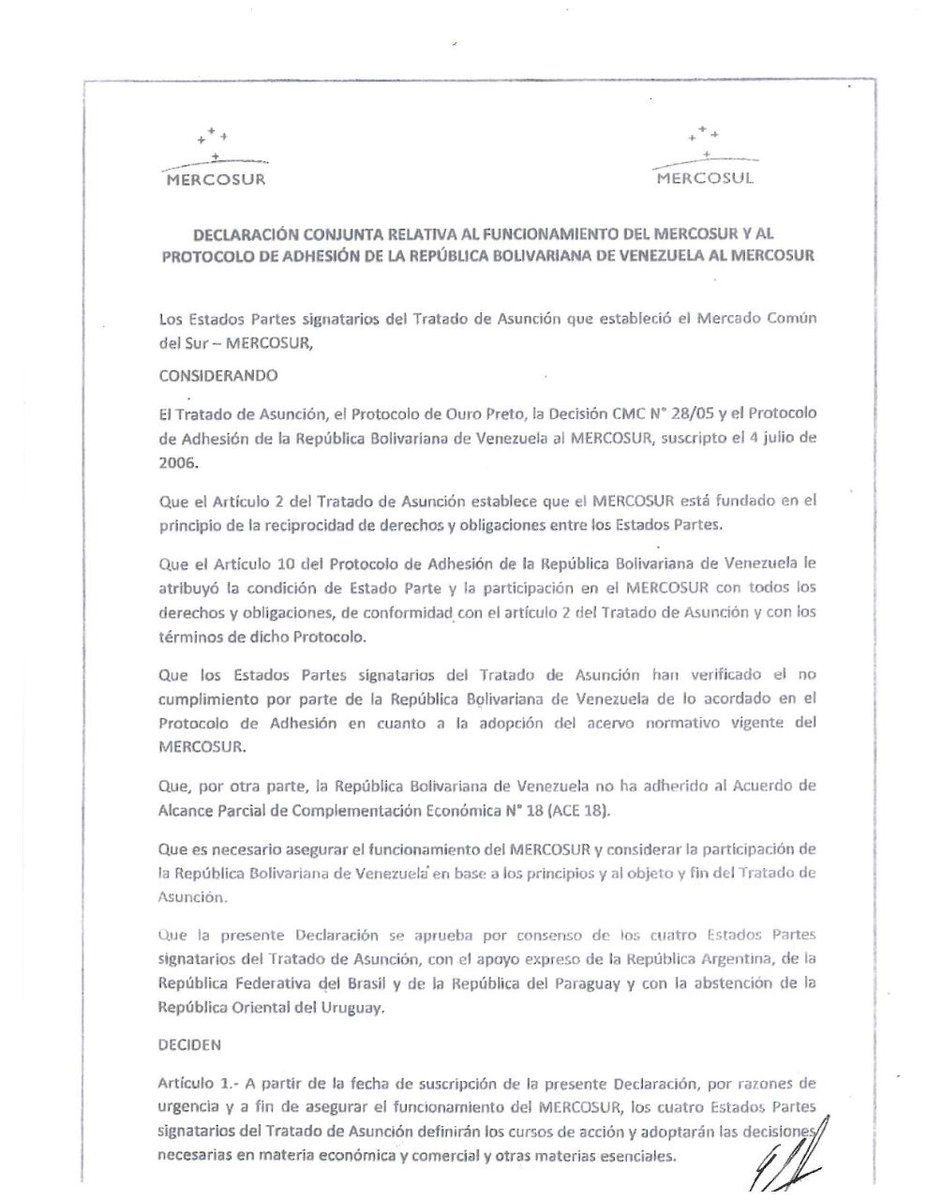
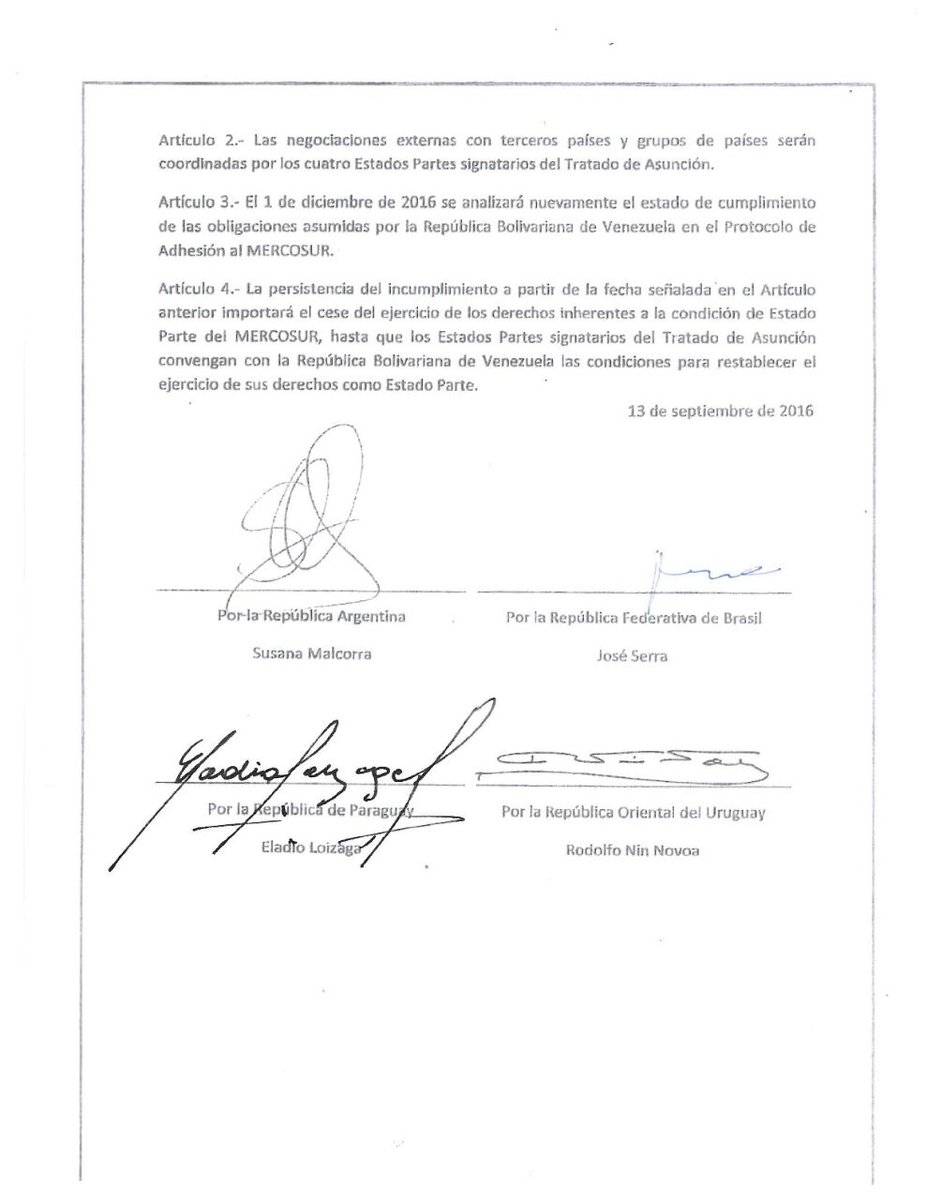
Al pie los lectores de habla hispana encontrarán el documento del Mercosur firmado por los Cancilleres de los cuatro Países Fundadores

Our readers outside Mercosur, but interested in what happens in this region of South America, need some clarification regarding the situation today.

It is extremely difficult to try and be objective. Politics have a weight in this matter that one cannot ignore, and politics is something we usually try not to discuss in our blog. However, it is the new political trend that has been developing in this part of the Americas, that has a significant bearing on what has happened last Tuesday at the level of the Mercosur Council, their top ruling collective body.

On Tuesday last, the four Mercosur founding countries - Argentina, Brazil, Paraguay and Uruguay- issued a joint declaration stating that “the four Founding Countries approved today [Tuesday] a note by consensus, according to which note Venezuela will not sit at the [pro tempore] presidency, which as from now will be conducted by means of a coordinating committee formed by one representative for each of the founders”.
Uruguay agreed to sign this declaration, but not before it was agreed to give the government of Venezuela an exceptional additional period, up to December 1st, in order that they incorporate into their own legislation some 300 odd pieces of Mercosur legislation still pending of incorporation, part of the conditions established within Mercosur to become a full fledged member, which the four founders consider Venezuela still is not.
Seas of ink have already been shed while discussing this question. We have no intention of discussing it further. We have limited ourselves to state what has been decided at the top, 48 hours ago.
Does this mean the end? By all means, no. However, even if Venezuela disagrees violently with the decision, the statement and the formation of the four-member coordinating committee, allow Mercosur to manoeuvre and steer away from paralysis, a situation that had begun to threaten the flow of trade, and the operation of the those bodies that are essential to Mercosur’s way of life: the Common Market Group (GMC), the Commerce Committee (CCM) and such essential bodies as CT1, the Technical Committee where questions related to tariffs are settled. No minor stuff indeed.
It will also allow Mercosur to continue their protracted negotiation with the EU and begin to feel their way towards the Pacific Alliance.
The situation is still a complex one, but a path forward is now in place.

Mauricio López Dardaine

NOTE: Article 4 of the Mercosur document here bellow, states in no uncertain terms, that should Venezuela persist in non compliance with regard to the incorporation of the legal instruments still lacking incorportation [as of December 1st. 2016] this "will imply ceasing to be able to make use of the rights corresponding to a Member State", until the Member States agree with Venezuela the conditions relative to Venezuela regaining full fledged member status. 


Declaración conjunta relativa al funcionamiento del Mercosur y al Protocolo de Adhesión de la República Bolivariana de Venezuela al Mercosurhttps://pbs.twimg.com/media/CsUoiDSWEAAT1sd.jpg

https://pbs.twimg.com/media/CsUoi1sWEAARoNP.jpg


volver